


A few months ago, a CEO at a VC firm asked me to describe my skillset.
I took a breath and did my best. Marketing, I said. Brand positioning. Design taste — the kind where you can look at a layout and know immediately what’s wrong without needing a rubric. AI systems: I build and operate agent infrastructure for research, editorial, quality review, and publishing. Content engineering. PMM. I’ve worked on product direction, helped take a company to acquisition, shipped consumer apps, and I write a newsletter about all of it.
She nodded slowly. Processing it.
Then… “So what’s the job title for that?”
I didn’t have one.
I still don’t have a perfectly crisp one. But I’ve been thinking about it a lot, and I think the job I’m doing (the one I want to get increasingly good at) is best described as *marketing engineer.*
I’ve been intentionally avoiding the term ‘Engineer’ like the plague for fear that my far more technically gifted, far earlier in life friends might roll their eyes at me in disgust. But I think the job has been, inevitably, emerging for a while. It doesn’t necessarily have a lane yet, doesn’t have a canonical job description, doesn’t have an industry body lobbying for it. It’s a thing that, increasingly, people like me are falling into rather than planning for.
Which is how I got here.
What a marketing engineer actually is
A “technical marketer” usually means someone who can read a dashboard, set up UTM parameters, and speak coherently with an engineer. Useful. Not the same thing. A “growth hacker” is mostly dead framing, and what it described was usually performance marketing and light product intuition stapled together with the promise of hockey sticks. Marketing ops and rev ops are different jobs. And a product marketer who learned Python is still a product marketer who learned Python… and someone who nobody wants to hang out with at the company retreats.
A marketing engineer is someone who builds governed systems that turn market evidence into measurable marketing action.
The emphasis is on *systems* and *governed.* The engineering is not about code specifically. It’s about the design of something reliable, maintainable, and honest about what it can and can’t do. It’s about thinking clearly enough about a problem that you can specify it precisely. And it’s about being willing to be accountable to what the system actually produces, not just what you intended it to produce.
That last part is the crucial element.
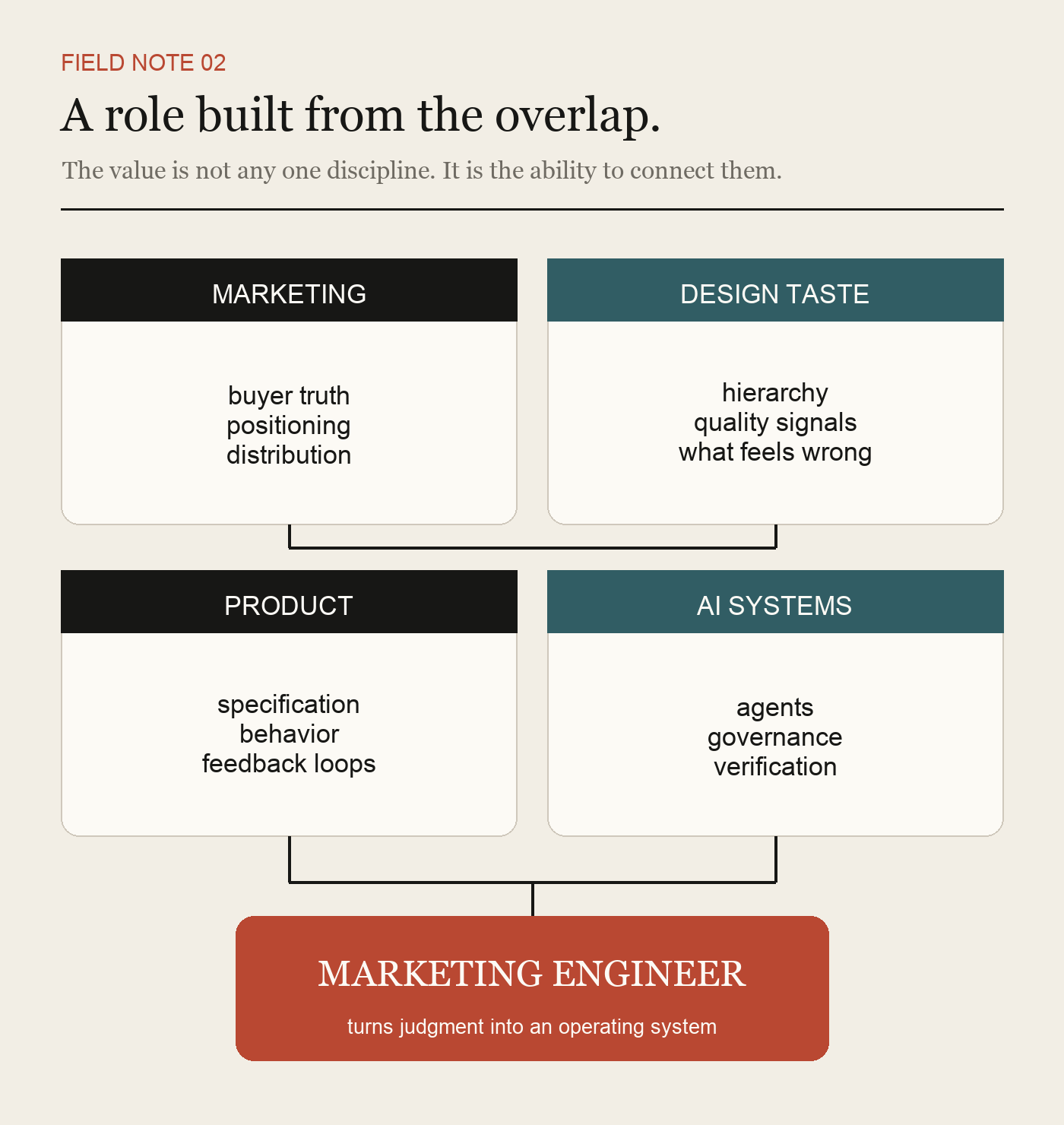
The best budding marketing engineers I can think of tend to share a specific combination of capabilities… they understand how buyers actually think, they can encode that understanding into repeatable processes and tools, they can work at the intersection of strategy and implementation without losing either one, and they are weirdly comfortable sitting at the junction of craft, judgment, and technical systems.
It’s also a job where taste matters in a way that’s hard to explain to a CFO. Not aesthetic taste for its own sake. Taste as a quality signal. The ability to know when a system is producing something good versus something technically correct but wrong, and to course-correct without burning the whole thing down.
This is different from “I have opinions about fonts.” It’s more like… when you run thirty AI-assisted content variants and twenty-seven of them have the structure right but are somehow missing the thing that makes a real person stop scrolling, you can tell immediately and you can say precisely why.
That’s a trained sense, and it atrophies if you stop using it.
Most marketing structures don’t build this sense. They reward throughput.
The long way here
I was a filmmaker first.
Not in a “I made some YouTube videos in college” way. In a “I spent years editing countless hours of footage in a bedroom trying to figure out what made a sequence of clips feel like something instead of just a bunch of clips” way. I wanted to be a filmmaker. That was my “plan”.
This is important context because what filmmaking taught me was not creative expression or artistic vision or any of the words people put on filmmaker bios. What it taught me was this… the decisions that determine whether something is good are invisible to the audience. The edit, the pacing, the order, the specific moment a cut happens. The thing that makes a motorcycle doc legendary instead of just footage of piping and flybys is a hundred undetectable decisions made at 3am by someone who cares more than the situation requires.
That’s the skill. And I had no idea at the time that it would transfer to, quite literally, everything else.
I ended up in content marketing at a startup almost by accident. I was doing strategic direction work for large enterprise brands at an agency and someone needed help with content and I needed money and that was the whole strategic plan. But within a few months, I noticed something… most of what passes for “marketing strategy” at early-stage startups is actually a list of activities with no underlying model. We post because we should post. We write a blog because SEO is good. We send a newsletter because people recommended it. There’s no governing logic. No way to know if it’s working. No mechanism for learning.
This bothered me the same way bad editing bothered me. Not aesthetically. Functionally. A system without a feedback loop isn’t a system. It’s a to-do list.
So I started building one.
A real content system: with intake, voice standards, source banks, quality gates, repurposing logic, and measurement that connected content to real buyer behavior. Not a content calendar. A system that could learn.
By the time I was done, other people at the company wanted to know how we built it. Then people at other companies started asking. And that is how, eight months after I joined Averi, the company decided to pivot around the content operating system I had built and turn it into the product.
The moment the system became a product
I want to tell this story accurately because I’ve seen it get compressed in ways that lose the part that actually matters.
I didn’t walk into Averi with a product vision. I walked in with a marketing problem and an emerging, though unfulfilled, systems instinct. The product vision came from watching the system work and realizing that the hard part, the part no one had turned into software yet, was all the stuff that happened *before* the draft.
Most AI content tools start at the draft. That was already too late.
The real work was what is the company trying to be known for, what does the buyer actually believe before they encounter you, what evidence do you have that your claims are true, how do you translate that into a durable content strategy that doesn’t turn into random production.
That’s a system. And systems can be encoded.
After the pivot, I worked directly with the CTO to guide product direction and propose features. This is not how I thought my marketing career would go. I was a filmmaker who fell into agencies, then fell into SaaS content marketing. And now I was sitting in product conversations trying to articulate why “the AI should produce the brief before the draft” and “the content system needs a memory layer, not just a history tab” and “quality is not a vibe check at the end, it’s a constraint you build in at the beginning.”
What I was doing, and I didn’t have a name for it at the time, was effectively marketing engineering. Encoding judgment into a system. Making the implicit explicit. Building something that could operate at scale without losing the things that made it good.
By the time Averi reached acquisition, the content and growth system had helped scale the company to more than 3 million monthly Google impressions, more than 100,000 AI citations, and more than 35,000 monthly organic site visits. But the more durable thing the experience produced was a way of thinking. A set of design principles for how marketing systems should work.
That’s the thing I carried out.
The professional uncanny valley
Here is the weird part about living at this intersection… no one knows what to do with you at first.
Traditional marketing people think you’re too technical. Engineers think you’re too soft. Product people think you’re too opinionated about things that aren’t in the roadmap. And every time you try to explain what you actually do, you end up making it sound like either “I’m just a really thorough marketer” or “I’m a frustrated engineer who couldn’t code” when it’s neither.
There’s a specific version of this that happens in job interviews.
You’re applying for a PMM role and the hiring manager is looking for someone to own messaging and run launch campaigns. You start talking about systems architecture and feedback loops and they smile politely. Or you’re in a conversation about a more technical role and you mention “marketing” and the energy shifts slightly because now they’re not sure what you are.
It’s a professional uncanny valley. Close enough to recognizable roles to confuse people, far enough from any single category that you don’t fully fit.
I’ve learned to stop apologizing for this. The roles that compound the most are usually the ones that don’t fit neatly.
But there’s a real cost to operating without a category… you don’t get the community, you don’t get the canonical career path, you have to define the standard yourself. And when you’re doing work that’s genuinely at the frontier of what a marketing person does, there’s no external signal that tells you you’re doing it right.
You have to develop your own.
It’s essentially perfect for me.
Of course I ended up here
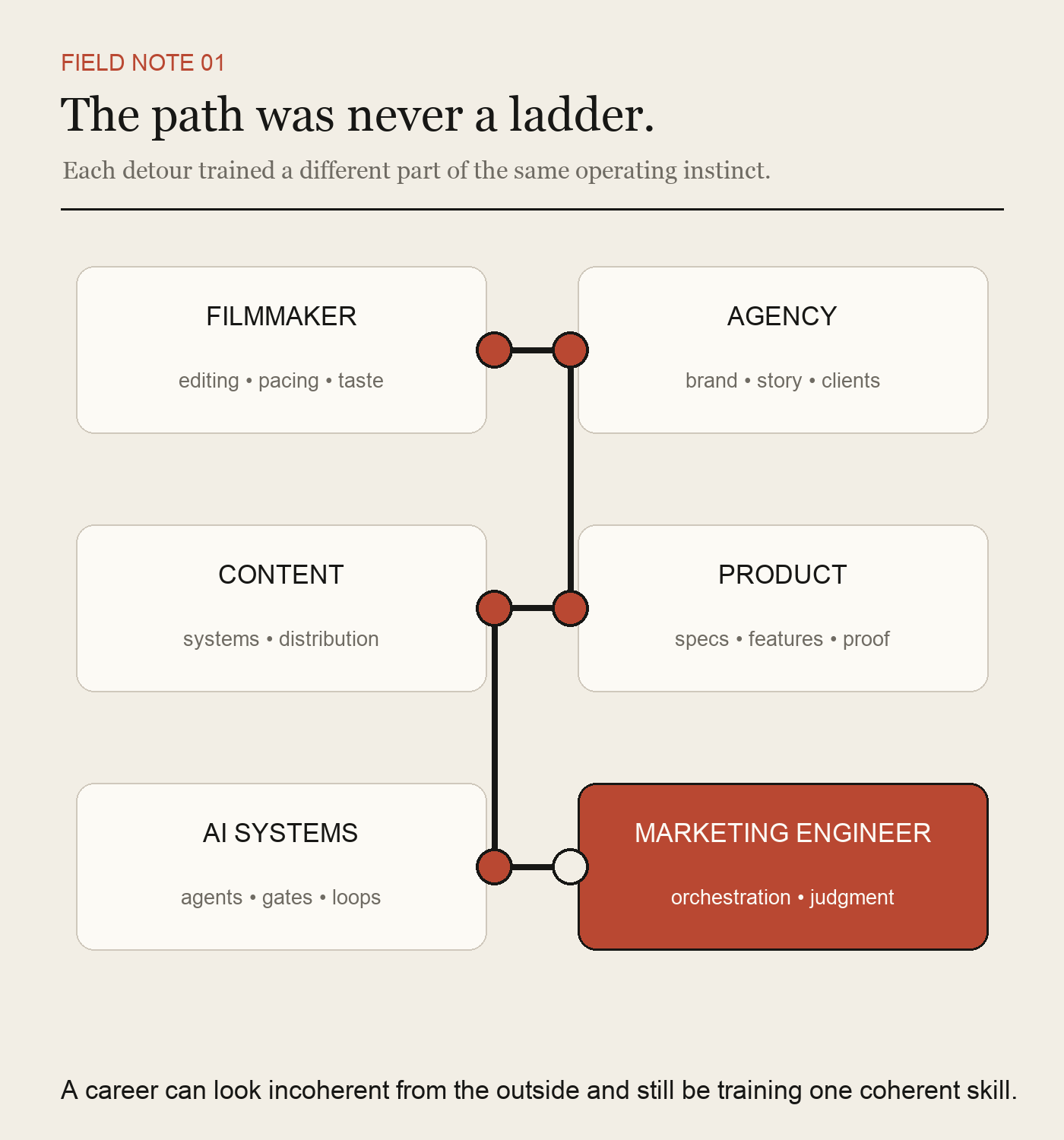
Most of my career has been a refusal, conscious or otherwise, to stay inside the job I was hired to do.
I entered through video and started asking brand questions. I entered marketing and started building systems. I built the system and started asking product questions. I moved deeper into SaaS and started wiring together agents, verification gates, design specifications, and operating loops.
On a résumé, that can look restless. Maybe even unfocused. I have never been especially good at following the path that already exists or staying inside the box that makes a role easy to explain. Every time I got competent at one discipline, I became interested in the machinery underneath it and wandered into the next room.
For most of my career, that made me harder to categorize. Now the technology is catching up to the way I already work.
The old boundaries made more sense when each craft required a separate set of tools and a separate specialist to operate them. AI is collapsing the distance between an idea and a working artifact. A person with taste, market judgment, and enough systems fluency can now move from research to positioning to interface to prototype without handing the work through five disconnected teams.
That does not mean one person should become a mediocre version of five specialists. I have no interest in cosplaying as an engineer because an agent helped me ship an app. The opportunity is to become unusually good at connecting the disciplines: to know enough about each one to define the problem, direct the work, recognize when the result is wrong, and pull the pieces into one coherent system.
Seen that way, marketing engineering does not feel like a random title I found. It feels like the first role shaped like the way I have always worked.
The emerging technology did not suddenly make me different. It made the collection of things I was already obsessed with more useful together.
Why this particular combination matters more now
AI didn’t create this job. But it made it legible, and it raised the stakes considerably.
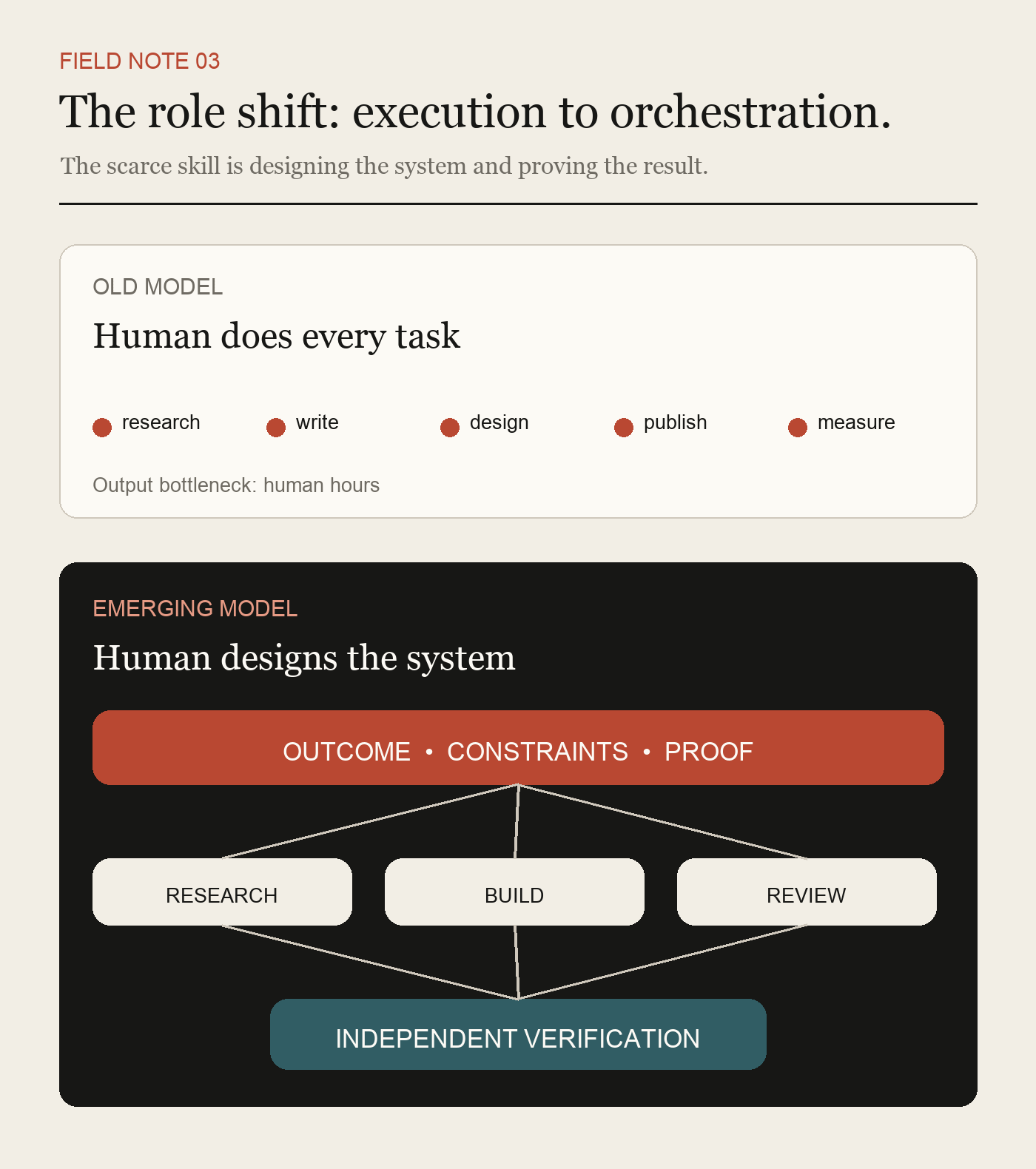
When AI tools became good, the execution layer got cheap. You can now produce ten times as much content, ten times as many variants, ten times as many audience-segment messages without proportionally more human effort. That’s real. Every marketer who hasn’t noticed this is about to have a bad year.
But the demos always skip this part: volume without judgment produces noise with better grammar.
I’ve watched this play out in real time.
A content team adopts AI tools and goes from producing 10 pieces a month to 80 pieces a month. Open rates drop. Engagement drops. The content *sounds* fine. It hits all the structural markers. But it doesn’t have the specific thing that made their original 10 pieces worth reading… a point of view rooted in something true about the buyer, written with enough specificity that it couldn’t have been written about any other company.
AI can produce the structure. It can’t produce the evidence.
It can’t tell you which of the thirty frames you could use actually aligns with what your best customers say when they explain why they chose you.
It can’t decide that the blog post about your feature is actually hiding the more important story about the problem the feature solves.
It can’t feel the difference between a headline that will stop a real person and a headline that a language model thought was the right shape of a headline.
Those are judgment calls. And judgment, unlike execution, doesn’t get cheaper when you add compute.
There’s a cleaner way to describe the role shift this forces.
The most capable AI systems right now are most useful when they’re running the system, not doing the task. Anthropic’s latest models are designed to plan, delegate, verify, and keep a set of workers pointed at one finish line — not to be the person typing every keyboard command. The person who designed that system still has to exist. Someone has to define the destination, set the constraints, own the quality gates, and decide what counts as finished. That work cannot be automated away. Someone has to do it.
The people who will get squeezed over the next decade are the ones who operated primarily in the execution layer: who produced content, ran the playbook, managed the calendar, and called it marketing.
Those who will compound are the ones who moved into the orchestration layer — who can encode the judgment, design the system, delegate the labor to cheaper agents, and inspect what comes back. Not just prompts. Governed systems with real inputs, real quality gates, and a definition of done that can’t be satisfied with a confident paragraph.
The technical part isn’t “knowing how to code.” It’s being able to think clearly enough about a problem that you can specify it precisely. Which, ironically, turns out to be the same skill that makes code work, and the same skill that makes marketing work, and the same skill that makes any tool do something useful rather than something expensive.
What I’m building right now
I said earlier that the lasting thing I took from Averi was a way of thinking. Let me make that concrete.
Right now, I coordinate an AI agent infrastructure that handles research, editorial planning, content drafting, quality review, and distribution across this newsletter and my LinkedIn presence. It runs on a set of voice standards, taste libraries, anti-slop review scripts, source banks, and quality gates that I built and maintain. The system doesn’t write for me. It operates from the judgment I’ve encoded into it, and I review every output before it goes anywhere.
At Cohley, I’m building PMM workflows that treat AI as a governed collaborator: with explicit constraints, documented decisions, and accountability to real measurement rather than activity metrics. The goal is not “we use AI in marketing now.” The goal is a specific system I can instrument, run a controlled intervention through, measure, and document as a case study.
Alongside that, I’m building something exciting, a product for the agentic web, where I’ve been running a design-authority-first workflow… write the full product specification before a single screen gets built, use that spec as the governing document for every AI-assisted design and code output, and treat every deviation from the spec as a signal about whether the spec or the output is wrong.
This is marketing engineering applied to product: encode the judgment before you start producing.
And I’m writing here, obnoxiously often in this newsletter, about all of it.
Not because I have a completed arc to share. Because naming and defining a field is part of creating it, and someone has to do it in public while it’s still being figured out.
I volunteer as tribute.
The honest gap
The cleaner version of this essay would tell a story of a completed arc: built the system, measured it, packaged it, sold it to fifty CMOs at a conference, now accepting consulting inquiries.
The actual state is more provisional than that.
I have a lot of architecture.
I have real proof of work: the Averi content system, the acquisition outcome, the personal publishing infrastructure, the current AI agent setup, the startup design-authority workflow. But the gap I keep bumping into is the distance between designed and built and exercised, repeated, measured, and packaged into something another person could use.
I’ve built content systems that worked inside specific contexts. I haven’t yet taken one fully through the complete loop to my satisfaction… first deployment to measurable business outcome to public case study to replicable process that someone else can pick up and run.
That’s the next phase. Not more system design. More disciplined operating proof.
Part of why this is slower than I’d like: companies don’t always have clean data. Stakeholders don’t always align on the metric. “Marketing engineer” is a hard sell when the dominant mental model of what a PMM does involves a lot of slides and a lot of meetings and a quarterly review where you show how many pieces of content the team produced. And the feedback loop between “built a better system” and “here is measurable evidence that the system produced better outcomes” is long.
Six months at minimum. Sometimes a year.
I’m learning to be okay with that timeline without using it as cover for not doing the work.
There’s also a version of this I’m less comfortable admitting: I’m more comfortable designing systems than I am sitting in the uncomfortable middle of operating them.
The design phase is satisfying.
The operating phase is where you find out all the ways the design was wrong.
I’m working on developing the same appetite for the operating feedback as I have for the initial architecture. That’s the actual growth edge, not learning another tool.
Why I want to be one of the best
Not “the best.” That framing is mostly for LinkedIn headlines. But one of the best. A person who, when someone else trying to figure this out goes looking for examples of what marketing engineering actually looks like in practice, finds my work and finds it worth learning from.
I want this for a few reasons, and I’m going to be honest about which reasons are respectable and which ones are just about ego and blind f*cking ambition.
The respectable reason: this field is going to matter enormously over the next decade, and it doesn’t have enough good practitioners yet. Someone who does it at a high level and documents it publicly is creating reference material that didn’t exist before.
That’s genuinely useful.
Not in a noble-calling way, but in a “the world will actually work better if more marketers know how to think about systems and proof and accountability” way.
The less respectable reason: I want to be known for something that’s true about me. Not “he was a good marketer at a few companies.” Something with more precision than that. The specific thing I can do, at the specific intersection I’ve spent ten years finding, turned into a body of work that’s unmistakably mine.
I had aspirations of reaching that level in hockey. I had a version of this in filmmaking. I had opinions about editing that I would have defended to anyone. I had a taste that was identifiable. I lost some of that legibility in the transitions between roles, and I want it back in the field where I’ve ended up.
What it actually takes
I’ve been thinking about this in terms of what makes a marketing engineer someone clients, employers, or readers would actually trust to build something consequential.
The proof has to be real and public.
Not “I worked at a company where something good happened” but “here is a specific system I designed, here is what it produced, here is what it cost, here is what I’d do differently.”
The acquisition outcome at Averi certainly helps. The metrics help. But they’re not enough by themselves, because an outcome you contributed to is not the same as a system you can reproduce.
The technical independence has to be at the right layer.
Not “I can write Python” but “I can specify a problem precisely enough that a code agent can implement it, and I can verify the result without taking the agent’s word for it.” That’s a meaningful line to cross, and most marketers haven’t crossed it.
It’s also different from being an engineer… I’m not writing production code. I’m being precise enough about what the code needs to do that good code becomes possible.
The judgment has to be visible and documented.
Not inside a strategy deck that lives on a private drive but in the work itself: in DESIGN.md files, in CLAUDE.md files, in structured handoffs, in documented decisions with reasons and outcomes attached.
The standard I use for this: could a capable person read the documentation I’ve left and understand what the system does and why it was designed this way? If not, the judgment isn’t actually encoded. It’s still in my head, which means it leaves when I do.
And the field has to be defined.
Not by waiting for a job board to create the category but by writing about it, building it publicly, showing the work in real time. That’s what this newsletter is for. That’s what the design-authority for my upcoming company’s workflow is for. That’s what the proof bank I maintain is for. Define it by doing it well enough that other people can see what it looks like when it’s working.
Five questions that will tell you if you’re already one
1. When you inherit a marketing system from someone else, do you immediately want to understand the underlying model, or do you just learn where the buttons are?
2. Can you write a real specification for a marketing asset (a contract with inputs, constraints, quality tests, and a definition of done) and hand it to an agent or contractor and get something useful back?
3. Do you have documented opinions about *why* something worked, or just the results?
4. When AI produces something technically correct but wrong, can you name precisely what makes it wrong? Not “it doesn’t feel right.” The actual thing.
5. When a system you built stops working, is your first instinct to look at the design, or to blame the tool?
If most of those are yes, you’re probably already doing this job. You just might not have a name for it yet.
That seems to be where we are as a field. A job that exists but doesn’t have a title. Work that matters but doesn’t have a canonical career path. A set of skills that compound but don’t show up legibly on a résumé designed for a different era.
I started as a kid editing skate footage until it felt like something. The edit no one sees is the thing that makes the thing worth watching.
I’m still doing that, just in a different medium.
Being early to a category is usually better than arriving late to a crowded one.
The work is to build the proof. Not the theory. The proof.
I’m working on it.
-zc
P.S. If you’re not subscribed to Don’t Feed The Algorithm, you’re getting this from someone who thought it was worth sharing.
I write about AI, marketing systems, and staying human while building things that matter. It’s a good newsletter, I’m told by my mom and a few thousand strangers.
Rabbit hole for the overcaffeinated:
- Pure UI — Guillermo Rauch’s 2015 essay on declarative UI. The short version: if you can encode state precisely enough, the rendering becomes almost automatic. This is where the `DESIGN.md → agent → rendered interface` workflow comes from, but the original insight is broader and applies to any system where specification quality determines output quality. Which is what marketing engineering actually is.
- Marketing Technology Landscape Supergraphic — Scott Brinker at chiefmartec.com has been mapping the MarTech stack for 15 years. The point is not the number (8,000+ tools). The point is that this complexity requires someone who can make sense of it at a system level, not just operate individual platforms. That person needs a name.
- What distinguishes the best growth thinkers — Lenny Rachitsky on mental models over tactics. Same underlying premise: depth in one area, judgment across the whole.
- The Next AI Skill Isn’t Prompt Engineering. It’s Graph Engineering. is a related argument about how AI changes the skill premium in knowledge work.
I have identified as a Marketing Technologist for much of my 20 year career. I see this is a specialist role within the marketing department that deeply understands various customer-reaching systems from the web platform to the CRM to any lead generating systems or 3rd party marketplaces, including all the integrations and how those interoperate, technically. Though my current title is Technical Marketer, which lies not within marketing, but in product and is a completely different kind of role that deals with GTM-readiness of product information. The titles sound interchangeable and yet the skill sets are wildly different. I don't expect people outside of Product, Marketing, Engineering, and Design to grasp the nuances. Plenty of folks with those titles struggle to decipher the difference themselves. The outlook for most businesses to ever figure out titles and roles before they staff a world-class CMO with as much Design and Engineering background as they have business experience is...grim.